 |
|
|
|
|
|
|
|
|
|
|
 |
 |
 |
|
|||||||
 |
 |
|
||||||||
 |
 |
 |
 |
 |
 |
 |
|
|||
 |
|
|||||||||
One Cybercriminal at a Time
Attorneys general join forces to fight computer crimes
 |
|
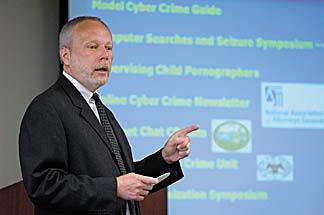
Thomas Clancy, director of the National Center for Justice and the Rule of Law at UM, addresses attorneys general from four states who met in Oxford to compare their cybercrime-fighting efforts. |
Attorneys general from four states met in Oxford this past spring to compare their efforts in combating cybercrime and to receive tips on achieving success.
The meeting, hosted by the National Center for Justice and the Rule of Law at the UM law school, kicked off a conference for the National Association of Attorneys General held on the UM campus annually.
Thomas Clancy, director of NCJRL, said the meeting’s purpose was two-fold.
“First, we were providing education on the scope of state cybercrime capacities; second, we were presenting results of a study the center did on how state attorneys general can develop and improve their cyber crime fighting capacities,” he said.
A cybercrime center for the state |
The NCJRL study, which was compiled into a book titled Combating Cyber Crime: Essential Tools and Effective Organizational Structures, included information on how states across the country have organized their cybercrime units, how to get funding for cybercrime efforts, laws surrounding digital evidence and the different functions of cybercrime units.
The study found law-enforcement officers are seeing all types of digital equipment—ranging from iPods and game systems to PDAs—being used to store digital information.
“So when you enter a house as an investigator, you have to recognize where digital evidence is,” Clancy told the attorneys general. “That’s the challenge, to be able to find digital evidence and use it in prosecution.”
Mississippi Attorney General Jim Hood and Colorado Attorney General John Suthers, who co-chaired the meeting, praised the study and the work to train prosecutors and law-enforcement agencies on cybercrime issues.
“When you go to something like this, you realize that you don’t have to reinvent the wheel,” Suthers said.
For Hood, the issue of cybercrime is crucially important, particularly because of the ways the Internet has made it easier for sexual molesters to solicit victims.
“It used to be that a sexual predator would have to work years to establish a relationship with a child, but today these predators have access to our children’s bedrooms through the Internet,” he said.
For more information about the National Center for Justice and the Rule of Law or to request a copy of the cybercrime study, visit www.ncjrl.org.
|
Because of that and the many other crimes perpetrated over the Internet, it is important for state and local prosecutors to be proactive in educating and protecting the public, he added.
“Twenty years down the road, I think we’ll be able to look back and say that we got in on the front end of these problems,” he said. “There are 26 AG’s offices that have cybercrime units, and those units are in a lot of different stages. We in Mississippi are in better shape than most as a result of the cooperation between the AG’s office, The University of Mississippi and Mississippi State University.”
MSU works with NCJRL to provide forensic training to police officers who investigate cybercrimes, while NCJRL staff provide legal training for both law-enforcement and prosecutorial officials. The training is one of a number of resources provided by the center. Other efforts include courses for trial judges focusing on computer searches and seizures, online information, CD-ROMs and special publications.
—Jennifer Farish© 12182007/3182i - The University of Mississippi Law School • Designed by The University Department of Publications