 |
|
|
|
|
|
|
|
|
|
|
 |
 |
 |
|
|||||||
 |
 |
|
||||||||
 |
 |
 |
 |
 |
 |
 |
|
|||
 |
|
|||||||||
At Long Last, Justice
Mississippi Innocence Project begins work
on correcting criminal justice system’s biggest mistakes
 |
|
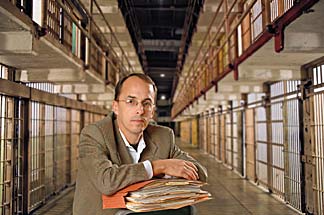
Mississippi Innocence Project Director Tucker Carrington is committed to finding justice for state inmates who have been wrongfully convicted. |
Cedric Willis of Jackson was convicted in 1997 of murder and robbery and sentenced to life in prison despite the fact that DNA evidence excluded him as the perpetrator.
Sentenced at age 19 to life plus 90 additional years for three robberies, Willis said he felt completely heartbroken when the conviction was handed down.
“To see my mom crying and to have them telling me that I would never be able to be at home with my son again, I really can’t explain how heartbreaking it was,” he said.
Thanks to help from the Innocence Project New Orleans, Willis was granted a new trial, found innocent and freed from prison in 2006. To help those like Willis who are serving time for crimes they did not commit, the Mississippi Innocence Project at The University of Mississippi School of Law was announced last spring.
It is stories like Willis’s that fuel the desires of those working with the Mississippi Innocence Project, including its director, Tucker Carrington, formerly a visiting professor at Georgetown law school. Carrington said the program is committed to providing legal representation to its clients: state prisoners serving significant periods of incarceration who have cognizable claims of wrongful conviction.
Throughout the fall semester, the project will continue to identify and investigate other potential cases, and, by January 2008, plans call for it to become an integral part of the law school’s course offerings. In addition, college and university students from around the state who are studying law and journalism will be involved in investigating the cases.
Besides serving its clients, the project seeks to identify systemic problems in the state’s criminal justice system and develop initiatives designed to raise public and political awareness of the prevalence, causes and societal costs of wrongful convictions, Carrington said.
Carrington said the Mississippi project already is consulting on the case of Kennedy Brewer, a Noxubee County man who served 15 years for the rape and murder of a 3-year-old. Brewer was released in August on bail after DNA results showed that he was not the person who raped the girl.
Initial funding for the project came from author and UM law alumnus John Grisham and Columbus attorney Wilbur Colom, a graduate of Antioch School of Law.
Colom said he did not hesitate to support the project when asked by his friend and longtime UM law professor George Cochran, who has worked tirelessly on establishing the project.
“I’ve known for years what programs like this have done in other places,” Colom said. “I cannot think of any greater service for students at the law school and students interested in investigative journalism [to provide], or any better way for those students to hone their skills and talents.”
Cochran said he became interested in the idea of creating an innocence project at the university as a result of his experience as a board member on the Innocence Project New Orleans.
“That project, directed by Emily Maw, has, in the past two years, succeeded in securing the release of five wrongfully convicted prisoners,” Cochran said.
Maw said such projects are important because “like it or not, our criminal justice system incarcerates innocent people for very long prison terms.”
There have been 207 post-conviction DNA exonerations in the United States since 1989 and well over 200 additional post-conviction exonerations that involved other traditional evidence of innocence, she said.
“If it were not for innocence projects, there would be virtually no way for innocent prisoners to get legal help to get out of prison,” she said. “State prisons in Louisiana and Mississippi contain almost exclusively poor people. Therefore, the innocent among them cannot afford to hire a lawyer to prove their innocence. And a very large percentage of prisoners in both states are functionally illiterate, so even if they weren’t stuck behind razor wire, they wouldn’t be able to advocate for themselves.”
Maw said the Innocence Project New Orleans has received more than 2,000 requests for help since it was established in 2001. The cases are put through an intensive screening process, and the project accepts cases only in which there is compelling evidence of innocence.
The Innocence Project New Orleans was eager to help establish the Mississippi Innocence Project because, since 2003, the IPNO has been accepting cases from the state of Mississippi.
“We very quickly realized that, while we could pursue some cases and start to lay the groundwork for innocence litigation in the state, there needed to be a full-time office in Mississippi. Having a small, nonprofit office of three lawyers in New Orleans trying to cover both states was not enough,” Maw said.
The Mississippi Innocence Project will be a statewide effort involving college and university students from around the state who are studying law and journalism. A number of people, including renowned journalist and UM journalism professor Curtis Wilkie, have pledged their support.
“There is a desperate need for these types of centers and the kind of representation and outreach they provide,” Carrington said. “The sheer number of exonerations nationally and the discussions about them are irrefutable proof that wrongful convictions are not isolated, rare events. They are a result of systemic defects in our criminal justice system.”
He added that the goal of the project is to provide front line advocacy for meritorious claims and find ways to prevent these injustices.
“The worth of innocence projects elsewhere around the country has been proved over and over again,” said UM law Dean Samuel M. Davis. “The Mississippi Innocence Project will add a valuable dimension to the education of our students and will provide a much needed service to the clients it serves. I am deeply grateful to John, Wilbur and George for the leadership they have provided to get the project off the ground.”
For Willis, it’s an easy decision to lend support the Mississippi Innocence Project because it is something he says is greatly needed.
Willis spent 12 years in jail before he was released due to the advocacy of the Innocence Project New Orleans. In September 2005, the Circuit Court of Hinds County reversed his conviction and granted him a new trial on all counts. In March 2006, the court determined that the eyewitness identifications were inadmissible at a new trial and, upon joint motion of the defense and the state, dismissed the charges against him. An hour later, Willis walked down the front steps of the Hinds County jail into the arms of his family and supporters.
“I believe there are people who are out there who need help. You run into a lot of people in jail who say they are innocent, and, after what I went through in the courtroom, I know that innocent people can be put in jail,” Willis said.
Authors team up to support project
Two award-winning writers teamed up to raise money for the newly formed Mississippi Innocence Project at The University of Mississippi School of Law in October.
John Grisham and Scott Turow headlined a fundraising dinner Oct. 22 in Jackson to support the project, which recently began operation.
Grisham (JD 81) is the author of numerous novels and other books, including his most recent, The Innocent Man, profiling a man wrongfully convicted and freed years later with the help of several attorneys. Turow, a 1978 graduate of Harvard Law School, also has written numerous books, including Presumed Innocent and Ultimate Punishment.
Both authors have supported similar projects in law schools across the country. However, the dinner marked the first time the two have jointly raised money for such a cause. Announced in spring 2007, the Mississippi Innocence Project was established with initial funding by Grisham and Columbus attorney Wilbur Colom, a graduate of Antioch School of Law.
© 12182007/3182i - The University of Mississippi Law School • Designed by The University Department of Publications