 |
|
|
|
|
|
|
|
|
|
|
 |
 |
 |
|
|||||||
 |
 |
|
||||||||
 |
 |
 |
 |
 |
 |
 |
|
|||
 |
|
|||||||||
Role Reversal
With government regulations growing at a dizzying rate,
physicians and other health-care providers must rely
more and more on the care and advice of their attorneys
Jennifer Farish
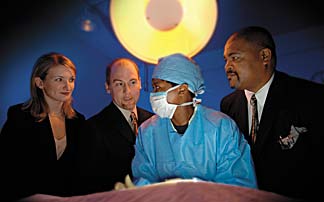 |
A shift is taking place place in the medical world. The providers of health care are becoming patients themselves as they become more and more reliant on lawyers specializing in medical issues. This dependence of doctors, hospitals, researchers and scientists on those who interpret complex and changing regulations is creating a wide-reaching need for attorneys who are well-versed in the ins and outs of health care. That is leading to a growing number of law students who are pursuing careers in health law.
One of those students is UM law student Claire Cowart, who got a very personal glimpse at the overlap between medicine and law. In 2000, as a freshman at Vanderbilt University, she under-went a surgical biopsy to determine if a spot on her breast was cancerous.
“During the biopsy, my surgeon sampled some tissue to determine if I was genetically predisposed for breast cancer,” Cowart said.
Neither she nor her family had given the surgeon permission or knew he planned to perform the extra test, and the seemingly warranted extra precaution actually created more worry for the entire family.
“My surgeon’s decision to test the tissue sample was a perfectly appropriate medical decision, one that would greatly assist my doctors in providing me treatment now and in the years to come,” Cowart said. “However, if the test results showed I was genetically predisposed, it could have meant being denied insurance coverage for the rest of my life for a cancer with which I had yet to be diagnosed.”
And there were no laws to protect Cowart from losing insurance or facing higher insurance rates if the test showed she was genetically predisposed for breast cancer.
 |
In 1996, the Health Insurance Portability and Accountability Act (HIPAA) provided the first federal protection against genetic discrimination in health insurance. However, HIPAA only applied to group insurance plans, not individual plans, and the act did not address whether higher rates could be charged for people with genetic predispositions.
Since that time, 41 states have enacted legislation dealing with genetic testing and health insurance. However, Congress has not yet passed a federal law specifically addressing this area. The result is what has been called a “largely untested patchwork” of state and federal regulations, and it is just one example of where medical technology advanced so quickly that the law has been unable to provide answers to the questions raised, Cowart said.
Though the genetic test ended up showing she was not predisposed for breast cancer, the issues raised by the unexpected procedure opened Cowart’s eyes to the ways that advances in the field of medicine can create challenging legal dilemmas.
Cowart, a third-year law student planning to specialize in health-care compliance issues, is one of more than two dozen UM law students who have chosen to pursue health law as a career.
It is a rapidly expanding area for lawyers, but less than 20 years ago health law was a largely unrecognized field. Instead, budding attorneys were handed cases concerning health issues lumped in with tax and corporate law cases.
Though corporate issues still are a major part of the health-law field—after all, hospitals and physician private practices are businesses—those issues are just the tip of the iceberg. Today, health-law issues involve everything from genetic testing, as in Cowart’s case, to the problem of physicians who cheat insurance companies through fraud and double billing.
Dinetia Newman (JD 89), a health lawyer and partner with Phelps Dunbar in its Tupelo office, said Medicare and Medicaid issues, including compliance with the Anti-Kickback Act and Stark law, are hot-button issues in the field, as well as compliance issues dealing with the life sciences. The term life sciences has come to encompass laws dealing with the development and distribution of prescription drugs, biotechnical products, bioethical issues, genomics and many other new areas created by the advances of medical research and treatments.
Katie Gilchrist (JD 91), UM adjunct professor of law and partner with Adams & Reese in Jackson, added that the availability and cost of health insurance remains a big issue as well.
“Obviously, the national health-care quandary and how that will be addressed in the upcoming presidential election is front and center, and will continue to be,” she said. “In addition to that, though, the issue of privacy of patient information and the requirements of the HIPPA law, the upcoming new Stark regulations prohibiting self-referrals by physicians, the recent e-discovery rules and many other issues are dominating the field.”
Newman, who also is a member of the board of directors of the American Health Lawyers Association, said the ever-changing regulatory scheme of health law—Congress enacts a budget bill annually that includes revisions to the Medicare and Medicaid programs—means attorneys, doctors, researchers and hospitals constantly struggle to stay up to date.
“Health law is very fast-paced in terms of the changing laws and client demand,” she said. “For example, every morning before I go to work, I read several daily reports of activities in the health-law arena.”
There are numerous other reasons that health law is growing so rapidly as a specialized field of law, many of them having to do with the impact of the large baby boomer generation on Medicare and other insurance programs.
“When you have a government partner such as Medicare spending the amounts it spends on an aging baby boomer population, one can anticipate considerable attention to framework,” Newman said.
Add to that the pharmaceutical aspect of Medicare Part D, and you have even more incentive for the federal and state governments to be sure their money is being managed wisely.
 |
Health care is the largest sector of the U.S. economy, the largest employer in the U.S. and the largest expenditure of our federal government, said Richard Cowart (JD 78), longtime health-law attorney, former president of the American Health Lawyers Association and father to Claire.
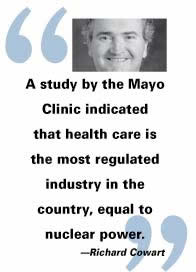
“A study by the Mayo Clinic indicated that health care is the most regulated industry in the country, equal to nuclear power,” he said. “With literally tens of thousands of pages of existing regulations and new ones every day, just keeping up with the law, much less the science of the industry, is a daily challenge.”
And as the health-law field as a whole expands, there is a corollary growth in student interest at the UM School of Law.
Gilchrist joined the UM faculty in the fall of 2006 teaching one health-law course, but demand already has necessitated her now teaching two health-law courses in addition to her full-time law practice. She also serves as faculty adviser for the Ole Miss chapter of the American Health Lawyers Association, which started in the fall of 2006 as a result of student interest.
Building on a seminar and lecture hosted by the organization this past school year, the chapter plans to sponsor presentations in the fall and spring of this year.
“Interest in the field is unquestionably growing amongst the ranks of law students,” Gilchrist said. “Last fall, when Ole Miss’s law school decided to make a health-law class available, I had nine students in my class. In the spring, that number grew to 18. This semester, I am teaching nearly 30, and the class was full after the first day of registration.”
Dean Samuel M. Davis said the health-law course and organization at the law school grew out of interest from law students and health lawyers in the state.
“Dinetia Newman talked to me a couple of years ago about offering a health-law course and about getting a student chapter of the American Health Lawyers Association started, and fortunately Katie Gilchrist came along at just the right time to meet that need,” he said. “We are fortunate to have alumni such as Dinetia and Katie, and Dick Cowart, who is one of the top people in the country in health law, who are helping us meet this growing need.”
The elder Cowart said that as a student at the UM School of Law, he served a year as a student member on the Mississippi Board of Bar Commissioners.
“It helped me realize at a young age the importance of professional societies to the legal profession,” he said. “I commend these students on their early recognition and their initiative in becoming actively involved at this stage of their legal careers.”
Claire Cowart fortunately was not diagnosed with breast cancer, and the genetic test showed she is not predisposed to the disease. However, it is not difficult for her to recall the stress of that first biopsy.
“Going into the biopsy, I was concerned about the present, my health at that very moment,” she said. “The genetic test created a new concern, this one about the future—would my access to health insurance be restricted for the rest of my life because I was genetically predisposed for a cancer that I didn’t have? The implications of both tests were completely overwhelming for me as a 19-year-old.”
Cowart added she sees the expansion of health law as a sign that health-care companies are realizing the importance of hiring attorneys who not only have a broad understanding of legal issues, but who also have a broad understanding of the health-care industry.
“Years ago, the term ‘health lawyer’ might have been synonymous with medical malpractice. Today, the term describes attorneys practicing all types of law who have specialized their practice to the health-care community,” she said. “And as the health-care industry continues to grow, the need for attorneys specializing in the field will continue to grow.”
Cowart plans to turn her own experience into a positive by joining the ranks of thousands of attorneys nationwide aiming to clarify the lines and rules between health care and law.
Jennifer Farish is a communications specialist with the Office of Media and Public Relations and the editor of the UM Lawyer.
Happenstance leads to rewarding careers
Unlike the students involved in health law early in their education, the field’s emergence over the past two decades means many of today’s experts on health law did not set out to focus on health-care issues as law students.
Both Dinetia Newman and Katie Gilchrist, now recognized leaders in Mississippi health-law issues, say their introduction to the field of health law was primarily accidental.
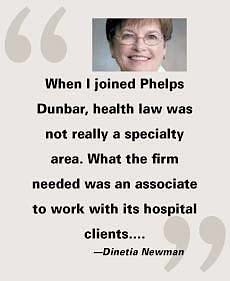
“I was a nontraditional law student, graduating from law school at the age of 46, and, at that time, wanting to be a business lawyer,” Newman said. “When I joined Phelps Dunbar, health law was not really a specialty area. What the firm needed, however, was an associate to work with its hospital clients and their regulatory concerns, and I became that person. So, I really got into health law at just the right time.”
 |
Gilchrist’s introduction to health law was even less the result of planning.
“A senior partner in my former law firm needed help on a certificate of need matter, and I volunteered,” she said. “I was hooked. After that CON matter, I began to learn the practice area generally, and, because of my firm’s representation of one of the major acute-care hospitals in Jackson, I had the opportunity to get involved in nearly every aspect of health law in a short period of time.”
For Richard Cowart, who has become a national expert on health-care issues, entrance into his field also was a happy accident.
“I was asked to form a group practice (HMO) for medical missionaries from our church,” he said. “It allowed the families of the medical missionaries to come and go as their kids grew up without having to build and disassemble the medical practice.”
In doing so, Cowart learned the federal approval practice as a volunteer, and not long after that, a client of the law firm he worked for had a health regulatory issue arise.
“I was the only person at the office with health regulatory experience and thus became the resident expert at the firm on the matter,” he said.
For each of the three attorneys, their resulting careers as health lawyers have been extremely rewarding.
“I have found that the health-law practice area, more than other areas in which I have practiced in my 16 years since law school, really allows me to feel like I’m contributing to the quality of people’s lives—to helping people,” Gilchrist said. “And that is why I went to law school in the first place.”
© 12182007/3182i - The University of Mississippi Law School • Designed by The University Department of Publications