 |
|
|
|
|
|
|
|
|
|
|
 |
 |
 |
|
|||||||
 |
 |
|
||||||||
 |
 |
 |
 |
 |
 |
 |
|
|||
 |
|
|||||||||
Village People
Former residents of married student housing
reminisce about their law school days on eve of Village demolition
In early October, parts of the university’s married student housing known as the Village began to come down to make room for the new law school facility.
The original “Village” was built in 1946 and was known as “Vet Village” because it provided housing for G.I.s who enrolled at Ole Miss after serving in World War II. Most of the Village as it exists today was constructed in 1959, with additional buildings added in the early and mid-1960s as the original post-World War II structures were demolished. The Village occupies 18 acres and, when fully occupied, provided housing for 318 families, primarily married students.
Throughout the years, hundreds of law students have called the Village home while they pursued their UM degrees. When the new law school building opens in 2010, some law alumni will be stepping on familiar ground when they walk through the doors. There might even be a piece of the actual apartment they occupied in the new facility. Ian Banner, facilities planner for UM, said much of the material from the Village will be graded down and used as the foundation for the new law school.
The plan to recycle the materials has a number of environmentally friendly benefits: The old materials will not take up space in a landfill, and the university will not be using gas and resources to truck new foundation materials in and old foundation materials out, Banner said.
The new law school will be the first building on campus to be certified by the Leadership in Energy and Environmental Design (LEED) program, sponsored by the U.S. Green Building Council. The program is a nationally accepted benchmark for the design, construction and operation of high-performance green buildings.
In anticipation of the changes on that piece of land, a few former Village residents took the time to share some of the things they will remember about their time in married student housing.
Chickens in the breezeway
 |
|
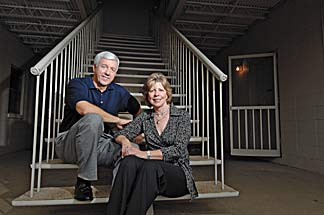
John and Shelia McCullouch |
My wife, Shelia, and I felt very fortunate to be able to live in the Village while in law school. We had been out of undergraduate school for more than six years, and had two young boys and not much money; so it fit our price range perfectly.
Another good thing besides the cost to live there was getting to know your neighbors. Everyone was basically in the same boat from a financial standpoint. Neighbors were outside a lot, our kids played together constantly, and Friday night cookouts were really something to look forward to.
We’ll never forget our first visit to see our apartment—it was interesting in that there was a chicken coop of some sort in the breezeway with several chickens in it. We wondered what in the world we had gotten into. Actually, the housing department was very accommodating and moved us to a less “animated” building. That building was close to the fraternity houses, and we’ll always remember hearing those parties going on until the wee hours of the night. It was actually good entertainment.
One thing about the apartment itself was that it was so small you could see into all the rooms from any other room. In fact, it was so small that when we graduated and moved to a bigger place, the boys were scared when they couldn’t see everything that was going on in the whole place anymore.
We were most fortunate to be able to live in the Village during law school, and we look back on that time as one of the happiest times in our lives.
99-cent T-bones and community cookouts
 |
|
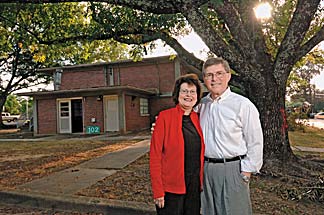
Samuel and Carolyn Davis |
We lived in an efficiency apartment our first year. The bathrooms in the apartments were back-to-back, and the walls were so thin (and uninsulated) that when you took a bath—and the person next door was taking one at the same time—you could hear the tub squeaking, not to mention any conversation that happened to be going on. It was as though you had someone in the tub with you.
My second year we “moved up” to a one-bedroom apartment.
That fall we bought an English setter puppy from Jere Hoar (former journalism department chair). Pets, of course, were forbidden in university housing. We tried our best to keep him under wraps. One morning I let him out to potty, and he ran over to greet a man who had just driven up and gotten out of his car. The “man” turned out to be none other than Binford T. Nash, the director of housing! And Barney was jumping all over him. He was very nice, but I knew our days were numbered. Sure enough, a few days later we got our eviction notice.
Those were great times in the Village. You got to know your neighbors, many of whom were fellow law students and their spouses, and often we would cook out together, grilling cheap steaks (T-bone steaks were expensive then, but occasionally when they went on sale for 99 cents a pound, we would get a couple) and occasionally some fish that someone had caught. We may have been poor, but the camaraderie among friends was priceless, and those friendships have lasted a lifetime.
The not-so-secrets of semi-private bathrooms
 |
|
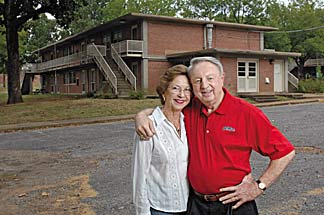
Sherman and Celia Muths |
Sherman and I moved into Bldg. 144 in Vet Village 48 years ago. Our building was just opened that year.
At that time, everyone in the village was married—its purpose was literally married students’ housing. Some of the original units left a lot to be desired. They are long since gone, making way for the Kappa Sigma house, etc. The buildings on the west side were unfurnished one-bedroom units. Those nearer Coliseum Drive were “efficiency” units, which were fully furnished and rented for $52.50 a month, including utilities! Air-conditioning was not an option, but we did have a window!
We had an efficiency—18 feet by 18 feet, one door to outside, one door for the bathroom, everything in sight and easily reachable! The sink, stove, oven and fridge were one unit—you could sit on the floor to clean the oven or fridge. It was a wonderful neighborhood within the campus— lots of law students, other graduate students, some who did their military obligations early and returned to college afterwards.
At that time, with a little planning, your week’s grocery bill at Big Star would be $20-$25. One wonderful man with a meat market on North Lamar had a special price for students. We took him Gulf Coast oysters after Thanksgiving in appreciation.
The buildings like we were in were designed with six apartments on each floor facing north, likewise facing south. This created a “cluster of bathrooms” in the center of four apartments. Acoustics at Ole Miss weren’t a big thing then. We could hear each others’ showers so easily, and we learned quickly not to have private conversations in those bathrooms. All the neighbors would clearly hear! You even heard the girl next door using her hair spray!
All of us in the Village were in similar circumstances, financially and otherwise. We devised a lot of inexpensive ways to entertain ourselves, for example, pooling our leftovers in one apartment to have dinner and watch “Playhouse 90” on Sunday night with the friend who actually had a television. Babies were sometimes there, asleep on the bed of the hosts. We were always having other students and even faculty members to supper in our cozy quarters. We were young and happy to be there together, and we have wonderful memories of the whole experience.
© 12182007/3182i - The University of Mississippi Law School • Designed by The University Department of Publications