 |
|
|
|
|
|
|
|
|
|
|
 |
 |
 |
|
|||||||
 |
 |
|
||||||||
 |
 |
 |
 |
 |
 |
 |
|
|||
 |
|
|||||||||
Faculty News
A Defining Moment
Former faculty member recalls being fascinated—and changed forever—by UM’s unusual elixir of civil rights unrest and Southern charm in 1960s
by Lauren Freeman
 |
|
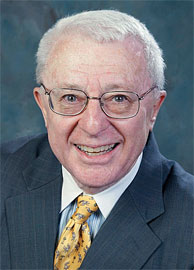
| Michael Horowitz |
From Cambodia to Eastern Europe and North Korea to Malawi, former UM School of Law professor Michael Horowitz has spent his life teaching, researching and fighting for civil justice reform.
Currently a senior fellow at the Hudson Institute, a Washington, D.C.-based public policy research organization, Horowitz’s writings reveal a man open about his conservative views, Jewish values and love of what his grandparents regularly told him was “the blessed land of America.” And he’s a fighter, especially when it comes to injustices such as sex trafficking, North Korean gulags, prison rape and the genocide in Darfur.
Horowitz developed his passion for fighting for civil justice throughout his youth and education, but it was greatly spurred by his experience as an associate professor at the UM School of Law in the mid-1960s.
It had been only a year since Horowitz graduated Yale Law School when he came to Mississippi in the summer of 1965. He arrived at a heated time in the state’s history, and racial tensions were still running high after Ole Miss’s integration only four years earlier. It was America’s hot spot—the front line in the battle over civil rights.
“Change was taking place, and I felt it was an extraordinary time to be a fly on the wall,” he said.
On the eve of his departure for Mississippi, Horowitz attended a New York dinner party where another guest was Mrs. Nathan Shwerner, the mother of civil rights worker Michael Shwerner, who was murdered by the Ku Klux Klan. Horowitz sensed that many Northerners believed the South was inferior to the rest of the country, yet he fervently rejected what he regarded as the cheap and easy role of a Yankee hero going into the dark and dangerous world of the South.
“I felt in the ’60s what I feel today: That good race relations were clearly more feasible in Mississippi than they ever could be in New York, Chicago or Los Angeles—places that treated the South in morally superior and patronizing ways despite the hypocrisy that governed race relations in those places,” he said.
Immediately fond of his new surroundings in the Deep South, Horowitz moved in with Grady Jolly, now Mississippi’s senior federal judge, and made his life in Oxford complete with two immediate purchases —a red convertible and a Tennessee walking horse he named Old Blaze.
“It was an intriguing world that I was made comfortable in from the start,” he said.
One of the reasons for this, Horowitz said, was understood by the Southern novelist Robert Penn Warren, who wrote of the powerful similarities between Jews and Southerners.
“We may be part of mainstream life of our societies,” said Horowitz, “but our histories teach us that good times are fragile and tragedy and isolation may be right around the corner. And we run the risk of being suffocated by the dead hands of our past rather than losing a sense of rootedness to family, culture and tradition.”
Over the course of the next two years, Horowitz taught the first black students enrolled at the UM law school, including the first black Mississippi Supreme Court justice, Reuben Anderson. Also in his classroom was future Mississippi Sen. Trent Lott, and one of his fellow faculty members was future UM Chancellor Robert Khayat.
Horowitz was an activist for racial reconciliation in the classroom, on the floor of the Mississippi Legislature and in the Ole Miss Department of Athletics. He was also pleased to help facilitate the guest appearance of Robert Kennedy at the UM law school, proving that healing from a divisive university integration not only could—but would—happen.
 |
|
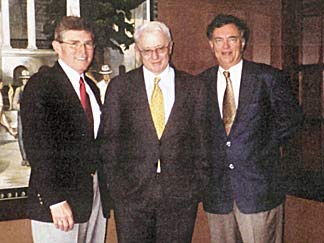
During a recent trip to Mississippi, former UM law professor Michael Horowitz (center) caught up with two of his former students, Dean Samuel M. Davis (left) and retired U.S. Attorney John Hailman. Horowitz taught many well-known graduates of the law school during his time in Oxford, including Mississippi Supreme Court justice Reuben Anderson and U.S. Sen. Trent Lott. |
One of Horowitz’s proudest contributions was the acquisition of a grant that allowed selected law students to work at legal service clinics in major U.S. cities. He said the sponsoring law firms had expressed skepticism that UM law students could fit into their ghetto legal clinics, but soon found that the students could communicate with the clinic’s clients with an openness that elite Northern lawyers never could.
Perhaps Horowitz’s largest role was as a professor in his freshman course on contracts.
“He was extremely enthusiastic and positive,” said John Hailman, a former student of Horowitz and a retired U.S. prosecutor from Oxford. “He made law so interesting.”
Horowitz’s unique teaching style was evident to his students whose first assignment was to write a sonnet. Horowitz emphasized that in order to write contracts, one needed to have “verbal facility,” Hailman recalled. The assignment was so distinctive that Hailman can still recite the ending lines to his sonnet 40 years later.
Law Dean Samuel M. Davis said Horowitz was a great teacher, and many a contracts problem involved the sale or trade of Old Blaze.
“I was fortunate to be one of the dozen or so students whom Mike sent around the country in the summer of 1967,” he said. “That experience [in New York City] broadened my horizon. In his role as teacher and mentor, he helped shape my values, values that are still with me today.”
Horowitz said that during his role as a professor, he emphasized to his students that he was there to learn as much as he was to teach, and that his students were there to do the same.
“The two years I spent teaching at the Ole Miss law school were among the most instructive, enjoyable and formative experiences of my lifetime,” Horowitz said.
One test of the positive power of his experience, Horowitz pointed out, is the fact that he still remains friends with many of his former Mississippi faculty colleagues, students and neighbors even though it’s been 40 years since he lived in the state.
The experiences and lessons Horowitz gathered while at the UM law school continue to inform his fight for human and civil rights around the globe.
Lauren Freeman is a writer in UM’s Office of Media and Public Relations.
© 12182007/3182i - The University of Mississippi Law School • Designed by The University Department of Publications