

















 by
Deborah Purnell
by
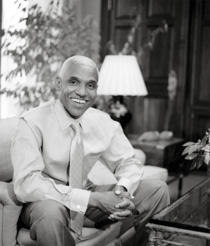
Deborah PurnellAs Shelby County Mayor AC Wharton Jr. begins his first full year in office, he reflects on the forces that got him there and how he plans to deliver on his promise to operate a successful county government.
AC Wharton Jr. ('71) was a small, skinny kid growing up in racially divided
Middle Tennessee when he gaped at two white police officers beating a
black man. The drama surrounding the racially charged court proceedings
that followed helped instill within Wharton the desire to help others.
"It's not the beating I remember most," says Wharton, explaining
why he has dedicated his life to public service. "It's the fact that
they didn't charge the cop-they charged Bob Junior, the man who was beaten."
Wharton, 57, parlayed that determination-mixed with a stylish charisma,
certain humility, and downright honesty-into a career that reads like
a Who's Who: political science degree from Tennessee State University,
law degree from The University of Mississippi, Shelby County (Tenn.) public
defender, partner in the law firm Wharton & Wharton & Associates,
University of Mississippi law professor, executive director of Memphis
Area Legal Services, investigator for the Equal Employment Opportunity
Commission, attorney for the Lawyers Committee for Civil Rights Under
Law, and mayor of Shelby County.
Elected Shelby County's first African-American mayor in 2002, Wharton
garnered 62 percent of the vote. He says "determination, luck, and
the belief of others [in him]" account for his win.
Wharton's life story has the elements of a made-for-TV movie. It's about
the middle child of five siblings from Lebanon, Tenn., who probably never
envisioned going to college and certainly never dreamed of becoming a
mayor.
The slight-framed Wharton says "you don't have to be a muscleman
to get things done," but you do need the support of family. "It
took a lot of help from my family to get me to where I am today. No man
is an island," Wharton says, discussing his recent mayoral win from
his office in downtown Memphis near the Mississippi River. "My mother,
who taught me patience, and my father, who taught me the virtue of hard
work, definitely contributed to my success.
"I live my life trying to instill those same virtues in my sons,
AC III, Alex, Andre, and Tavarski," Wharton continues. "Furthermore,
I approach every situation with a mapped-out plan for success."
Throughout his yearlong campaign for mayor, Wharton touted his plan for
success. His 20 points for operating a successful county government include
developing a liaison to address the complex needs of the cities and towns,
hiring qualified people for key positions based on skill and not political
connections, and maintaining a performance-based management system to
make county officials more accountable to the public.
"In Shelby County, there is no clear rule for what services are being
provided by county government and what services are really needed,"
Wharton says. "But I do believe all departments should be required
to report their goals and then measure their success to ensure good public
service." To hear Wharton tell it, planning and executing goals is
easy. It is something he says he learned in law school.
"To be prepared to handle any challenge is one of the reasons for
attending Ole Miss," he says. "As a student and former professor,
I know Ole Miss teaches its students to always have a purpose. While we
taught theory, we also taught the day-to-day nuts and bolts of going into
practice and living in the real world. "
While on the UM campus as a law student in the late 1960s, Wharton says
he made some lifelong friends and established contacts, but more importantly
he discovered he could "excel even in a racially charged environment."
"I came to Oxford just a few years after James Meredith became the
first African American to enroll at Ole Miss. Although the atmosphere
was still tense by 1968, my most memorable experience was when I realized
that, by and large, I would be graded fairly," Wharton says. "I
knew that, although I was not fully accepted socially because of my race,
I would be able to excel academically."
Wharton, who admits to having great fears and feeling isolated and even
slightly uncomfortable during his first year at UM, says he believes the
University has made significant strides in attracting, protecting, and
retaining African-American students. "No one with intellectual honesty
can say things have not changed for the better at Ole Miss. Things have
changed drastically," says Wharton, who was an adjunct law professor
on the Oxford campus from 1974 to 1999. "I suppose the biggest change
is that a support network is there. Not necessarily a physical support
network-I mean it's a network that supports the psyche, the immeasurable
and often intangible feeling of total comfort and acceptance, greatly
enhancing a student's chance for academic success.
"I think-in fact I know-that sort of network system is there now
because Dr. Khayat works hard to make all students feel safe and wanted
at Ole Miss."
When speaking of UM's 15th chancellor, Wharton smiles and acknowledges
that Khayat was not only his toughest law school professor but also his
favorite.
"Robert Khayat was a good guy then and is a good guy now," Wharton
says. "I remember going to him to talk about my grade. I felt I deserved
a better grade. But instead, he asked me if my heart was in the course.
It wasn't, of course. Khayat then took the time to explain to me that
you must give your all-mind, body, and soul-into something you really
want. That way, you will always do your best. I'll always remember that."
Chancellor Khayat speaks fondly of his former student. "He was a
student leader, but he also provided guidance to the dean and law faculty
as we worked through the adjustments and challenges that accompanied the
integration of higher education."
Law Dean Samuel M. Davis says he's not surprised at Wharton's accomplishments,
describing the former professor as a "person of great dignity and
integrity, with the inborn skill of leadership." "The people
of Tennessee can expect the very best from AC Wharton. That's what he
is about. He gave his best in a well-run, positive campaign and even more
as an Ole Miss student and later as a much admired professor."
Acknowledging again that his road to success was not traveled alone, the
new mayor credits Ruby, his wife of 31 years. "When I mentioned the
desire to run for office, my wife made sure I was running because I believed
I could bring change and innovative solutions to Shelby County,"
Wharton says. "When she realized I truly felt I could transcend racial
lines to bring together a better community, Ruby was beside me, encouraging
me every step of the way."
Sitting in his office on the eighth floor of the Shelby County Government
building, Wharton says his first day as mayor was filled with relief that
the campaign was finally over. "I didn't shout, and I haven't shouted
yet. I didn't walk into my new office and say, 'By God, I'm in charge,'"
Wharton says, as he stares out of his office window at the dimly lit city
below. "The enormity of my campaign promises hit me, and right then
I realized I have a lot of work to do. I will shout when I have come up
with a plan to keep people out of jail. I'll shout when I have done what
I promised I would do. It's time for me to get to work and give back to
a state that has given so much to me. I'm here to do a job, and when that
job is complete, maybe I'll shout. Maybe."
Deborah Purnell is a communications specialist in UM Media and Public
Relations.