

















Path
to Power
by Barbara Lago
Not since the first two years of the Eisenhower Administration have Republicans
controlled the White House, U.S. Senate, and House. These are heady days
for the GOP in Washington, and at Ole Miss, where four members of Congress
received their law degrees.
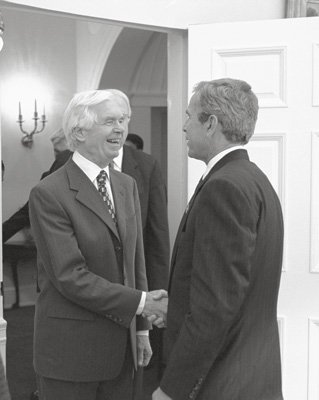 Historically,
the party out of the White House picks up seats in midterm elections.
But this go-round, the two senators and two representatives saw their
party buck history to reclaim control of the Senate and maintain its hold
on the House.
Historically,
the party out of the White House picks up seats in midterm elections.
But this go-round, the two senators and two representatives saw their
party buck history to reclaim control of the Senate and maintain its hold
on the House.
Alumnus and U.S. Sen. Thad Cochran (R-Miss.)—re-elected to his fifth
term—became head of the Agriculture, Nutrition, and Forestry Committee
and the Appropriations Committee’s Agriculture Subcommittee when
the Senate reorganized in January. His seniority over other Republicans
made him a shoo-in for both posts and gives him unmatched influence in
Congress on U.S. farm policy and spending. He also sits on the Rules and
Administration Committee.
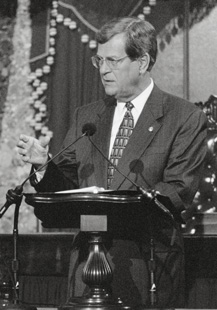 Alumnus
and U.S. Sen. Trent Lott (R-Miss.), despite a post-election controversy,
still looks forward to working with a GOP-controlled House and President
Bush on the Republican agenda. He chairs the Rules Committee and Commerce
Committee’s Aviation Subcommittee, and holds seats on Finance and
Intelligence committees.
Alumnus
and U.S. Sen. Trent Lott (R-Miss.), despite a post-election controversy,
still looks forward to working with a GOP-controlled House and President
Bush on the Republican agenda. He chairs the Rules Committee and Commerce
Committee’s Aviation Subcommittee, and holds seats on Finance and
Intelligence committees.
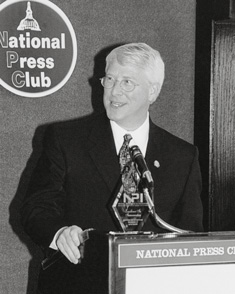
With its hold on the House, the Republicans also maintained control of
federal spending, since all such bills must begin there. That’s
especially of interest to alumnus and U.S. Rep. Roger Wicker (R-Miss.),
re-elected to his fifth term. Wicker has eight years on the Appropriations
Committee and says he’s “one or two terms away from being
a subcommittee chairman.” He’s also a House deputy whip, sits
on the Republican Policy Committee, and chairs the Congressional TVA Caucus.
The House is where two other GOP alumni have wielded influence: Rep. Kenny
Hulshof, re-elected to his fourth term in Missouri, and Rep. Ed Bryant
of Tennessee, who gave up his seat in January after an unsuccessful bid
for the Senate. Hulshof is on the powerful Ways and Means Committee, and
Budget and House Policy committees.
“ We are very proud of our congressional leadership in the Senate
and House and the fact that they received their law degrees from The University
of Mississippi School of Law,” said Dean Samuel Davis. “The
Law School has a great tradition of preparing people for not only the
practice of law but also public service and leadership in government.
All of these men continue that great tradition and honor their alma mater
with their exemplary service.”
All five alumni are quick to tell how the Law School helped prepare them
for the dog-eat-dog world of partisan politics.
“ The stakes went up in terms of competition when making the quantum
leap from undergraduate school to law school,” Bryant says. “That
competitive edge—if you didn’t have it by the time you got
to law school, you sure had it when you left.”
In politics, he says, “they step on your shoulder to get around
you. Having a law school background is very helpful in the legislative
process.”
Wicker says law school helped develop his analytical skills and the ability
to think through a problem and be quick on his feet. “Those are
all things that are important in Washington,” he says. “A
good law school teaches the prospective lawyer how to think.”
Rather than a dog fight, Cochran considers politics “a much more
serious undertaking of shaping public policy and representing the interests
of our state.” In terms of capabilities acquired at the Law School,
“learning to write persuasively and effectively was the best gift,
or most effective, most rewarding thing,” he says, in addition to
preparing him as a lawyer.
Hulshof says he took “every justice, criminal, and tax law course”
in law school. Then he returned to Missouri, where he spent 13 years in
his state’s criminal justice system, first as a court-appointed
public defender, then as a prosecutor, ultimately prosecuting death penalty
cases for the attorney general.
“ In politics, you must be able to communicate, so your ability
to write, to speak, or to move people with your words is so critically
important,” he says.
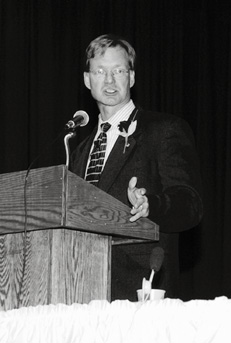 A
member of the Ways and Means Committee, Hulshof says, “Every tax
law that is written comes through our committee, so all of those tax law
courses have served me very well in that we are the committee that changes
the tax code.”
A
member of the Ways and Means Committee, Hulshof says, “Every tax
law that is written comes through our committee, so all of those tax law
courses have served me very well in that we are the committee that changes
the tax code.”
Reflecting on his law school days, Hulshof remembers being called on in
Professor George Cochran’s Constitutional Law class and being completely
unprepared. “I wanted to melt through the floor,” he says.
“I was standing there, and beads of sweat were popping out on my
brow, and I was being made an example of, as only Mr. Cochran could do.”
Painful as they were, Hulshof admits that such experiences “help
prepare you for whatever you choose to do.”
The other congressmen did not go unscathed. Cochran remembers an incident
while a freshman in Professor John Fox’s Contract Law class. In
discussing an old English case, Cochran mispronounced the word Leicestershire.
“Professor Fox said, ‘Hold on, wait a minute, time out for
culture,’” Cochran says. “I thought I had culture, and
I was embarrassed that we had to take time out for him to give me a little
added dose.”
On a lighter side, Wicker tells a story about Aaron Condon, who taught
him Criminal Procedure. Judge J.P. Coleman visited the Law School to preside
over a moot court event, and Condon appeared as a witness, dressed up
as an old hippie with sunglasses. “He was in total disguise and
disrupted the courtroom with his testimony,” says Wicker. “He
was a dear friend of Coleman’s, but Coleman didn’t know who
he was and was on the verge of throwing him out of the courtroom. It was
a riot.”
They also share stories about each other.
“ Trent Lott swears that any success I have,” Hulshof says,
“is because of my Ole Miss connection. He has told me that, actually.”
Hulshof almost believes it because of all the hoopla in 1994, when Wicker
and the other freshman GOP congressmen were the majority makers for the
Republicans.
“ Roger was elected by his classmates as president of the Freshman
Class of Republicans. That was something I was very aware of, so I sought
to be, and was elected, president of the freshman class of ‘96.”
Lott, Cochran, and Wicker are quick to point out how Mississippi’s
entire Republican congressional delegation—which includes Rep. Charles
W. “Chip” Pickering—supports funding for University
research.
“ We have brought a lot of money to the University for the School
of Pharmacy [housed in the Thad Cochran Research Center] and the National
Center for Physical Acoustics,” says Lott. “We have also worked
very closely with the University to make people around the country realize
what an outstanding academic institution it really is, and what great
leadership it has in Robert Khayat.”
The day Cochran, the senior senator, was interviewed for this story, he
announced two grants—one from the National Institutes of Health,
another from the Department of Health and Human Services—for additional
research programs that will, he says, “contribute to health care
in our state and nation.”
Both are “an indication of the recognition that has come to the
University for excellence in medical research. That’s now been replicated
in the Law School,” he says, referring to funding for the National
Center for Justice and the Rule of Law.
“ I think the Law School benefits from the overall standing of the
University, and I think that has been advanced by federal grants and programs
located in Oxford and on The University of Mississippi Medical Center
campus in Jackson.”
In fact, the delegation has increased Mississippi’s federal research
dollars “by probably 100 percent the eight years I’ve been
in Washington,” Wicker says. “We are showing that research
doesn’t all have to be done in Boston and Silicon Valley.”
For proof, he refers to a Sept. 27 Chronicle of Higher Education cover
story, “A Record Year for Academic Pork,” which ranks Mississippi
seventh in the nation for the federal funds it receives. Neither Wicker,
Lott, nor Cochran is much bothered by the term “pork.”
“ Congressman [Jamie] Whitten used to say, ‘Pork is a federal
project in somebody else’s district,’” Cochran says.
All five politicians believe national security is the nation’s most
critical issue.
“ Protecting the security of our country is the most important obligation
we have today,” Cochran says. “We are living in a dangerous
world, and the threat of terrorism and other challenges to our security
must be ranked as the most serious.”
Protecting Americans from a repeat of Sept. 11, 2001, “is going
to take a great degree of wisdom and leadership,” Wicker says. “We’ve
left one century where the threat was Nazism, fascism, and communism,
and the concept of mutually assured destruction. Now we face the problem
of Islamic fundamentalism, where hatred is ingrained in children and crosses
national lines. We can defeat anyone militarily, but defeating a people
determined to hate us is a long-term problem.”
Iraq poses another challenge and threat “that will dominate our
national media for some time, depending, of course, on how weapons inspections
go,” Hulshof says.
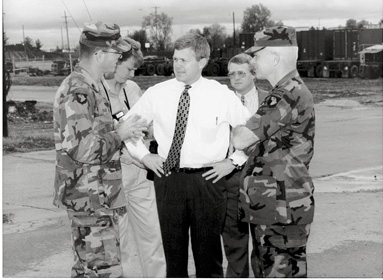 Bryant
is hopeful the country can maintain peace, so it can focus on pressing
domestic issues. Those raised by him and the other four congressmen include
the sluggish economy, the decimation of Americans’ pensions by corporate
CEOs, Social Security, and health care and its many facets, including
Medicare reimbursements, prescription drug costs, health insurance, and
medical malpractice insurance and damages.
Bryant
is hopeful the country can maintain peace, so it can focus on pressing
domestic issues. Those raised by him and the other four congressmen include
the sluggish economy, the decimation of Americans’ pensions by corporate
CEOs, Social Security, and health care and its many facets, including
Medicare reimbursements, prescription drug costs, health insurance, and
medical malpractice insurance and damages.
“ We have a continuing challenge of making sure that America keeps
those things that made it great,” Lott says. “We must make
sure we find ways to encourage economic growth and opportunity, and that
includes a good education. You don’t really benefit from the economic
system in America if you don’t have the basic education to take
advantage of it.”
When Lott and Cochran headed to Washington, Mississippi had a tradition
of powerful Democratic congressmen. They included the likes of John C.
Stennis, James O. Eastland, Jamie Lloyd Whitten, and G.V. “Sonny”
Montgomery. Lott and Cochran were elected to Congress in 1972. Lott represented
the Gulf Coast 5th District, while Cochran represented the Jackson-based
4th. Cochran made the jump to the Senate in 1978, succeeding the legendary
Eastland. Lott stayed in the House, rising to Republican whip during Reagan’s
presidency and getting elected to the Senate in 1988, succeeding the legendary
Stennis. He became majority leader in 1996, when Robert Dole (R-Kan.)
left the Senate during his unsuccessful bid for president.
Mississippi’s Republican congressional delegation expanded in 1994,
when Wicker captured Whitten’s northern 1st District, and again
in November 1995, when Mike Parker switched to the GOP after representing
the 4th District since 1989. Their gains continued in 1996, when Chip
Pickering won the east-central 3rd District seat following Montgomery’s
retirement.
Some think following in the footsteps of Mississippi’s powerful
Democratic delegation might be intimidating for the state’s “new”
Republicans. It’s not. Most of them draw inspiration from the legacy—and
that of others connected to the Law School, like L.Q.C. Lamar.
Lamar, Cochran says, “is one of those I look to for inspiration
in trying to achieve some degree of national influence as a United States
senator from Mississippi. In fact, I have four portraits on my office
wall that I had placed there when I was sworn into the Senate: Jefferson
Davis, L.Q.C. Lamar, John Sharp Williams, and Pat Harrison. At the time
I was elected, those four U.S. senators from our state came to mind as
the most influential in our state’s history. I have them here as
reminders of the influence Mississippi has had in the Senate and in our
nation’s government.”
Lott, who succeeded a 40-year representative, then a 40-year senator,
says it wasn’t until he got to the Senate and into its leadership
that he began to think about the great men who have served our state and
nation.
The room he sat in late last fall is the room in which Thomas Jefferson
was elected president of the United States. And across the hall from his
office was the room where the great debates with Daniel Webster and Henry
Clay and John C. Calhoun took place.
When in the Capitol, “you begin to realize that you are in an august
building, an institution where a lot of great history has taken place,
and that you can make some contribution,” Lott said.
Reflecting on Mississippi’s great statesmen, Wicker says, “We
have a lot to live up to. I think it’s important that we always
keep what (former) Rep. J.C. Watts calls ‘a sense of wow.’
When I am walking across the Capitol plaza late at night, and I see that
huge marble dome, it still does something to me.”
All five law alumni remember their first day in Washington, surrounded
by family, friends, and supporters as they were sworn in. It was especially
hectic for Wicker and Bryant.
“ There was nothing poetic about it,” Wicker says. “I
was about to go over and get sworn in, and my former neighbor came up
and told me my shoes were untied.”
It was a prelude of things to come. “We had promised to enact a
litany of House reforms on the first day, and in order to get it done,
we had to work into the wee hours of the morning,” Wicker says.
“ We were sworn in and started working,” says Bryant. “We
had a contract with America, in which we had pledged to do things within
the first 100 days. We were setting the standard with that first day’s
work, so we missed the parties and celebrations. We were the party poopers
at our own parties.”
When Hulshof went to Washington, his parents attended his swearing-in
ceremony. He remembers that January day in 1997.
“ We had a local press person following me and my family around,
and I remember Dad being asked, ‘What do you think about this day?’
And my father—who is not one for emotion—with tears welling
up in his eyes, told the reporter, ‘My boy is going to be in the
history books some day.’”
Eight months later, Hulshof had a bill in front of President Clinton,
and he got a call from Secretary of Agriculture Dan Glickman telling him
he had good news and bad news. The good news was that the president liked
Hulshof’s idea for value-added agriculture; the bad news was that
Clinton planned to veto the bill with the first-ever use of the line-item
veto.
“ I called my dad, and I said, ‘Dad, you were prophetic. I’m
in the history books. I just thought history would be kinder than this.’”
Hulshof says he had no intention of going into politics but caught the
bug when a Republican candidate for Congress pulled out of his district’s
race in the summer of 1994, a few months before the election.
“ The party was looking for someone to jump into the race against
a very well-known, very popular, and very well-funded 18-year conservative
Democratic incumbent [Harold Volkner],” he says. “With all
these high-profile murder cases I prosecuted, I thought I was going to
be a household name in the 9th District of Missouri, until we took that
first poll. I found out I was known by a whopping 3 percent, plus or minus
a 5 percent margin of error. So I wasn’t starting off very strong.”
Hulshof barely lost the race and went back to his job with the attorney
general. Two years later, he defeated Volkner and headed to Washington.
Wickers road to D.C. was far different.
“ This is my third career in Washington,” he says. “When
I was a junior in high school, I served as Jamie Whitten’s page.
In the early ’80s, I was a Rules Committee staffer for Trent Lott
when he was a House member. After having been a state senator for seven
years, the transition to Congress was painless.”
All five alumni say they probably could have made more money in private
law practice than public service. But the greatest cost is lost time with
families.
Hulsof’s family was in Missouri while he was being interviewed.
“I’m away from them this week, he said. “Even when we
return home, there are constituent demands to be taken into account.”
“ That’s one thing that is troublesome,” Lott says.
“It takes a lot of weekends on the road. Most people are at ball
games or with their families, and you’re in Florida, Montana, New
Jersey, or New York. That’s the only part I feel badly about, but
it’s been a great run.”
Hulshof agrees, saying, “The ability to be effective, to carve out
a niche, to have a piece of legislation become the law of the land after
a lot of hard work, those rewards clearly outweigh the personal challenges.”
If he were to propose a toast to Mississippi, Ole Miss, and its School
of Law for the progress they’ve made in the past 40 years, what
would he say?
“ I would be toasting not only the positive heritage and traditions—The
Grove on football Saturdays, those political giants we spoke of earlier—but
also its willingness to be open-minded and make progress where needed,”
he says.
“ That, to me, is where I would clink my glass to those of you
who still call Ole Miss and Mississippi home.”
Barbara Lago is director of UM Media and Public Relations.