

















Two Federal Judges, Journalist Tell of Integration Experience
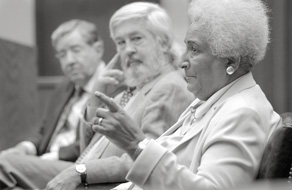 Three
significant players in the integration/desegregation of higher education
in Mississippi held a public discourse Sept. 30 at the UM Law School.
Three
significant players in the integration/desegregation of higher education
in Mississippi held a public discourse Sept. 30 at the UM Law School.
Senior federal district judges Constance Baker Motley and Neal B. Biggers
('63) joined veteran journalist Curtis Wilkie for the forum to help mark
the opening the University's yearlong observance of 40 years of integration.
Both Biggers and Wilkie were UM students in 1962 during integration; Motley
was James Meredith's chief legal counsel in his quest to integrate higher
education in the state.
Judge Biggers-who as senior judge of the U.S. District Court for the Northern
District of Mississippi issued the 2002 final decision in the historic
Ayers desegregation lawsuit-said his participation on the panel was based
primarily on his being a law student in 1962. Giving a firsthand account
of the furor surrounding Meredith's admission to the University, the judge
said, "I respected those marshals. I knew they were here doing something
they had been ordered to do."
Biggers recalled listening to a news bulletin informing the public that
President Kennedy had been assured by Gov. Ross Barnett that there would
be no violence surrounding Meredith's admission to the University, then
almost simultaneously hearing the "pop, pop, pop" of gunshots
on campus.
"National guard troops converged, and mobs waiting for them threw
bricks and molotov cocktails and the like," he said. The following
morning's aftermath of tear gas and scattered debris prevented anyone
from walking through the campus, he added.
Shortly after Meredith's enrollment, Biggers said he encountered the new
student, surrounded by federal marshals, playing golf on the UM course.
"They [the marshals] had rifles sticking out of their golf bags,"
Biggers said, adding that he introduced himself and had a friendly, student-to-student
conversation with Meredith. "He seemed happy as a lark," the
judge recalled.
"Everything changed the day James Meredith was admitted to The University
of Mississippi," said Wilkie, who received his bachelor's degree
in journalism from Ole Miss in 1963. (He was a newspaper reporter in the
Mississippi Delta during the height of the civil rights movement, before
beginning his illustrious career with the Boston Globe.)
Taking a different stance on his forum presentation, Wilkie described
the various factions of society that existed during the 1960s. "It's
important to know the environment and maybe appreciate how far we've come,"
he said, reminding listeners that it was the era of the Cold War and a
time of "great communist threat."
"It was very easy to connect outsiders with communist sympathizers,"
he said, referring to the way some people looked at the civil rights workers
who infiltrated the South. Wilkie also talked about "the voices we
heard" supporting segregation-newspapers around the state, citizens
groups, Protestant church leaders-"all saying the same thing: separation
of the races. So when James Meredith came to campus the stage was set."
Judge Motley, who serves on the U.S. District Court for the Southern District
of New York, opened her panel presentation saying, "As Judge Biggers
has made clear, what happened here 40 years ago was, we fought the last
battle of the Civil War." Telling of coming to Mississippi 22 times
during her work with Meredith, Motley said, "Every time, Medgar Evers
picked me up at the airport, drove me where I needed to go, and drove
me back."
The judge filed the Meredith case in May 1961, at a time of great civil
unrest in Mississippi, she said. "The Freedom Riders had come the
month before. So we walked into a Mississippi already inflamed with anti-black
sentiment. Judge [Sidney] Mize said, 'Why did you have to come now?,'
and I told him, 'We don't pick our clients.'"
Describing her encounter with Judge Mize and Judge Harold Cox as she presented
them with the citation holding Gov. Barnett in contempt of court, Motley
said, "Judge Mize put his hand on Judge Cox and said, 'It's over.'
Judge Mize was a civilized man. He knew he had a job to uphold the laws
of the Constitution of the United States. "Today, we can look back
at 40 years and see the progress we have made in this country-not only
at The University of Mississippi-but the whole country," Motley concluded.