

















 by
Angela Moore
by
Angela Moore
There are many battered women, abused children, and illegally evicted families in Mississippi who can’t afford a lawyer. A few get free help from UM's Civil Law Clinic—but it's the law students who feel lucky
In his first year at The University of Mississippi School
of Law, high achiever Sean Courtney eyed a career with a big law firm.
That is, before Professor Debbie Bell ('79) inspired him to go another
direction.
By the time he graduated in 2000, Courtney was president of the Law School’s
Public Interest Law Clinic, and he had received a fellowship with the
National Association of Public Interest Law, the first UM law graduate
to snag that honor. Within a year, the young attorney had founded the
Mississippi Consumer Assistance Program, an organization that has helped
almost 1,000 low-income families in the state get the legal help they
need.
Already Courtney has presented a case in front of the state Legislature
and landed on the front page of The Jackson (Miss.) Clarion-Ledger for
his efforts. Passionate about helping people, he says "there's not
another state that this kind of work is more important in than Mississippi."
He credits his former professor for steering his course.
"Without Professor Bell's guidance, I'd be punching a clock at some
law firm, and I wouldn’t be nearly as happy with my life,"
Courtney says.
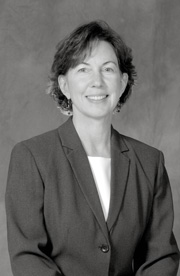 About
the time Courtney was leaving law school, Bell was expanding her Legal
Problems of Indigence class to include a new clinical component. Funded
by alumnus and writer John Grisham ('81) and his wife, Renée, the
UM Law School's Civil Law Clinic became a reality. Through the clinic's
hands-on training, Bell has sparked a desire in many more law students
to help those less fortunate.
About
the time Courtney was leaving law school, Bell was expanding her Legal
Problems of Indigence class to include a new clinical component. Funded
by alumnus and writer John Grisham ('81) and his wife, Renée, the
UM Law School's Civil Law Clinic became a reality. Through the clinic's
hands-on training, Bell has sparked a desire in many more law students
to help those less fortunate.
Initially, the clinic fielded 12 students serving indigent clients at
the Oxford Food Pantry and Interfaith Compassion Ministries, offering
to help them with landlord-tenant disputes, worker’s compensation,
disability claims, child custody disputes, and other legal problems. In
fall 2002, Bell enrolled 18 students who screened potential clients at
the two Oxford locations. Referrals also poured in from area battered
women’s shelters, family crisis centers, and other social service
agencies.
"We’ve even gotten calls from out-of-state people looking for
assistance for family members in Mississippi," Bell says.
The fledgling lawyers took on domestic violence cases—some secured
restraining orders for women in fear of their lives; others arranged for
the termination of parental rights and safe adoptions for abused children;
and still others investigated migrant labor camps, where several workers
each were charged as much as $1,000 a month to share a dilapidated trailer.
Such hands-on training for third-year law students is allowed under the
Limited Practice Act, provided a practicing attorney oversees them in
court. To meet that requirement, the clinic employs five local attorneys
as adjunct professors, including David Calder in consumer and domestic
violence cases, Anne Pitts in domestic violence, and Donna Gurley in consumer
law. Minnie Howard and Catherine Kilgore, attorneys for North Mississippi
Rural Legal Services, help students represent clients in every field.
Occasionally, students may be thrown headlong into emotionally charged
situations. Such was the case recently in a domestic violence suit in
which a woman suffered a broken neck at the hands of her husband, rendering
her a quadriplegic. After the woman eventually died from her injuries,
the students and their supervisor, Calder, continued to fight for her
rights, providing the district attorney in charge with information that
helped ensure the prosecution of her abuser.
The abuser pleaded guilty to two counts of manslaughter - one for his
wife and one for her unborn child lost as a result of the attack - and
was sentenced to 10 years in prison. Calder and the students now are representing
the deceased woman's sister in her petition for permanent custody of the
couple's surviving child.
"This is an eye-opening experience for me every day," Calder
says. "If we had not been there, who knows where this case would
be. This family couldn’t afford to hire the kind of representation
we provided them."
Funding dictates the number of students enrolled in the clinical class."Right
now I have to turn some students away,” Bell says. "But we
hope to begin a fund-raising effort soon to be able to expand the effectiveness
of the clinic. The indigent need is certainly there; we barely make a
dent in it."
In addition to the clinic’s goals to provide hands-on training for
law students and help for the indigent, Bell says she also hopes more
and more students will be inspired to continue their pro bono work after
graduation.
"Many students remember their clinical training as one of the most
invigorating and challenging parts of their legal education," says
the professor.
Former clinical student J.D. Shaw ('02), now an attorney with Watkins,
Ludlum, Winter and Stennis, P.A., was inspired.
"My work with the clinic opened my eyes, for the first time in my
life, to poverty in Mississippi," Shaw says. "My experience
also taught me that it’s often easy to help pro bono clients. A
lot of the time, it simply means helping to fill out a form, write a letter,
or make a couple of phone calls."
It’s graduates like Shaw and Courtney that fuel Bell's commitment
to finding ways to keep the clinic operational.For example, she has cut
overhead by operating a 'virtual office.' All case files are kept on a
computer, allowing students access via personal computer from any location
and enabling them to communicate with their lawyer advisers, post their
case-related activities, and update the database calendar.
"The system is an invaluable resource," Bell says, "because
the clinic doesn’t have to pay for a brick-and-mortar office space."
While Dean Samuel Davis says he would like nothing more than to get enough
funding to afford such space, he points out the significance of Bell’s
longtime efforts coupled with the Grishams’ funding. "We
are grateful to Professor Bell for faithfully using her abilities as a
creative thinker, teacher, and clinician, and to John and Renée
Grisham for their generosity in funding. Without them, the Law School
would not have been able to maintain the clinic for training students
and helping meet the needs of ordinary people with everyday legal problems,"
Davis says. "The current interest among students in hands-on experience
and the demonstrated legal needs of the indigent make us even more committed
to working toward a permanent, first-class clinic."
Angela Moore is a communications specialist in UM Media and Public
Relations.