

















Students get hands-on courtroom experience - and a professional edge over many of their peers - in two new programs.
by Mitchell Diggs
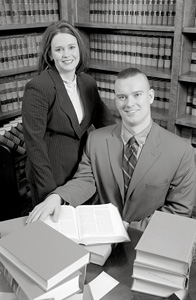 There's
an old adage that an attorney straight out of law school generally needs
help finding the courthouse door, but two new clinical programs at the UM
School of Law put students inside the courtroom arguing real cases.
There's
an old adage that an attorney straight out of law school generally needs
help finding the courthouse door, but two new clinical programs at the UM
School of Law put students inside the courtroom arguing real cases.Thanks to the Law School's new Criminal Appeals and Prosecutorial Externship programs-both established by the National Center for Justice and the Rule of Law-students have the opportunity to develop real-world legal skills.
Third-year student Kristy Callahan argued a brief in U.S. District Court. Her classmate Daniel Cornacchione presented two cases to a grand jury and interrogated witnesses in circuit court. And Sarah "Sadie" Gardner filed a brief with the Mississippi Supreme Court before her December 2002 graduation.
While the three fledgling attorneys rank near the top of their class, their hands-on courtroom experience is what gives them a professional edge over many of their peers.
"When a lot of people graduate from law school, they feel they really haven't learned how to be a lawyer," says Gardner, a participant in the appeals program. "They've learned how to read cases and understand the principles of the law, but this class has definitely given me a good feel for what is really required of a lawyer and what it's like to be a lawyer."
That assessment makes Phillip Broadhead smile. A clinical professor and director of the Criminal Appeals Clinic, Broadhead hopes to help students develop legal skills and gain the confidence to use them professionally.
Broadhead recalls being appointed Marion County public defender four years out of law school, then shortly thereafter having to handle the appeal of a case his predecessor had worked.
"I didn't know where to start because I had never done an appeal. I had written plenty of briefs in both law school and in office settings, but I'd never done anything like an appellate brief that you file with the Supreme Court."
Both the Criminal Appeals and Prosecutorial Externship programs became operational in fall 2002, offering classroom and field experiences to third-year students. Both programs include public service components and are designed to serve as models for other institutions.
The Prosecutorial Externship Clinic provides training in the prosecutor's role in the legal system and in the practical aspects of prosecuting criminal cases. Working under the supervision of a professional prosecutor, students prepare parts of actual cases for trials. The new program complements the Law School's externship program, which Professor Tom Mason has operated for some 20 years, placing students with prosecutors across the state.
In the new program's first semester, nine students worked in the offices of either the Lafayette County Attorney, Lafayette County District Attorney, Grenada County District Attorney, or the U.S. Attorney, researching issues, writing briefs, and participating in courtroom activities.
"They get to see the real-life workings of a prosecutor's office, and an additional benefit is that they get to cross the threshold of being in a courtroom on a professional level," says Hans Sinha, a clinical professor and director of the program. "That's a huge thing that most students never get to do while they're in law school. In state court, they can be sworn in and help try cases as a student attorney. They're not going to walk in and do a whole trial, but they can help prepare witnesses and sit at the counsel table and participate in the trial."
Some interns wade in deeper than might be expected, as was the case with Callahan, who spent much of the fall semester working in the U.S. Attorney's Office in Oxford. Attending a suppression hearing with her superiors, Callahan was both surprised and delighted when the judge called on her to argue a motion she had written for the case.
"The judge is an adjunct professor of mine, so he knew I had written it," she says. "He had already called me up to sit at the counsel table, and he called all the attorneys up before the closing arguments and told them what he was going to do, and they all agreed. It was a great experience." Both Kristy and her husband, Patrick Callahan, also a third-year student and participant in the Prosecutorial Externship Clinic with the U.S. Attorney's Office, got a broad range of experience during the semester. They researched a variety of legal issues, wrote briefs for the 5th Circuit Court of Appeals, and handled several misdemeanor cases.
"It's been very good for my writing skills and my research skills, which all lawyers use to varying degrees," says Patrick, an officer in the Marine Corps. "Even though it's a different setup in the military, I'll be able to use the things I've learned here in the Marines. These basic skills are good wherever you go."
The student attorneys tap into the knowledge and experiences of the professional prosecutors, gaining insights and knowledge that can take years to learn on the job, Sinha says.
"In most DA's offices, you're just kind of thrown in, and you learn by just doing the work," he says. "If you go to a DA's office where you do a lot of trial work, in a year or two, you'll have a couple of jury trials. Unless you go to a DA's office in New York or Los Angeles, or somewhere like that with a really focused training program, you probably will not get the academic training. You'll learn by yourself as you work on cases."
Cornacchione, who worked with a county prosecutor in Poplarville while in undergraduate school at William Carey College, has gotten a taste of nearly all facets of daily operations at the Lafayette County District Attorney's Office. He began his externship as the assistant district attorneys were preparing for a grand jury session, so Cornacchione spent dozens of hours sifting through police paperwork, preparing written indictments, and helping sort out legal issues. He helped present two cases-a drug trafficking arrest and an embezzlement case-to the grand jury.
"I got to experience being in front of a grand jury and interrogating witnesses," he says. "That was pretty cool, and I learned that I enjoy being in the courtroom."
Cornacchione also questioned witnesses during an aggravated assault trial and handled sentencing recommendations in several plea cases. Like Cornacchione, Kristy Callahan says she learned from her courtroom experiences that she enjoys the challenges of criminal and constitutional law. Students commit 140 to 280 hours during the semester, much of that on the job at their assigned prosecutor's offices, and get from 3 to 6 credit hours for the externship. But the classroom component is just as critical as the field work, says Sinha, who previously was an instructor and deputy director of the Tulane Law School Criminal Clinic. The academic segment includes training on the rules of evidence, court rules, ethics, and professionalism.
"They should understand the unique responsibility of a district attorney's office as the chief law enforcement officer in a district," says Sinha, who served as a prosecutor in metropolitan Orleans Parish, Louisiana, and later in one of the state's rural parishes.
"This puts them on a different plane from defense attorneys or even judges because they have a dual duty to prosecute the cases and also keep watch over the overall legal picture in their district. Young DAs and federal prosecutors often think the important thing is winning a trial, but the more seasoned you become, the overall picture becomes more important than any individual trial. That's a natural progression for prosecutors, but we're trying to give these students a sense of that from the beginning," he says.
Another of the program's goals is to ease manpower problems faced by many small prosecutor's offices.
"In the big metropolitan areas, the DA's offices may have 50 to 100 DAs and quite a large budget, but we often forget that the majority of DAs are rural prosecutors who work in small offices with real financial constraints," he says. "Part of what we're trying to develop are ways to provide aid to these rural prosecutors' offices that other universities will adopt."
Initially, the UM program is placing students with prosecutor's offices in Oxford and nearby towns, including Grenada and Batesville. Sinha says he hopes to expand the program to be offered in the summer session, allowing students to work farther afield, such as with the Mississippi Attorney General's Office and with other prosecutorial offices across the country.
 Likewise,
the Criminal Appeals Clinic has a quantifiable public service component.
Participants are admitted to limited practice and appointed by the Mississippi
Supreme Court to an actual criminal appeal of an indigent client.
Likewise,
the Criminal Appeals Clinic has a quantifiable public service component.
Participants are admitted to limited practice and appointed by the Mississippi
Supreme Court to an actual criminal appeal of an indigent client."For all intents and purposes, they are practicing attorneys in this one limited case under the direct supervision of an attorney," Broadhead says. "They get a case file, and they're responsible for doing all the research and following it through with a brief that gets filed with the Supreme Court. That's a very big thing. I had a lot of practical experience when I was in law school, but I never had the pleasure of seeing my name on something that was filed in court…until I was in actual practice."
Broadhead served as an assistant public defender in Hinds County and as public defender in Marion County, and is past president and a board member of the Mississippi Public Defenders Association. For advice on building the curriculum, he consulted colleagues at Georgetown University and George Washington University, which have similar programs.
The academic component covers the basics of appellate practice and procedure, the structure of a brief, writing styles, and research applications. It also includes replies and simulated oral arguments. The program enrolled three students initially, but one later withdrew. The students work in pairs, with each responsible for a case while serving as a consultant for his or her partner's case. The arrangement helps the student attorneys brainstorm and consider all sides of potential approaches, Broadhead says.
"In law school, you're basically an icon of one, and you're looking out for yourself and your grade. In this program, we set all that aside and begin working as teams within a firm. That's basically what we have here, a mini law firm, because once we're assigned a case, it's ours for all purposes. We carry the cases over from semester to semester and continue to work them until they're done."
The approach helps students spot their own strengths and areas where they need improvement, says Gardner, who plans to take the bar exam in February.
"I've really been surprised at how well I understand how the rules of evidence play into a case-and this is more from my partner's case than my own-and how the appeals process works in general," she says. "This class has really brought together the principles and ideas that I've learned in other classes and showed me how to combine them all into what I'm going to do the rest of my career."
Students spend 10 to 20 hours a week researching, writing, and discussing their cases, earning 4 credit hours for the semester's work. The amount of time required to put together an appeal surprised Gardner, who worked on a drug trafficking case. "I was unprepared for how much time it was going to take," she says. "You spend hours in the library doing the research, and then it takes just an incredibly long time to write the brief and get it in shape to file."
Both Broadhead and Sinha hope to expand the programs to include professional continuing education. Broadhead, for example, is developing a seminar on the basics of writing appeals that can be offered either on campus or at the bar convention. Both directors point out that their programs develop professional skills that are critical to attorneys in any type of practice.
"The principles that are being taught in this course can be applied to a civil appeal easily," Broadhead says. "You just convert your research applications to punitive damages or whatever the subject of the appeal involves. The research techniques and writing techniques apply across the board."
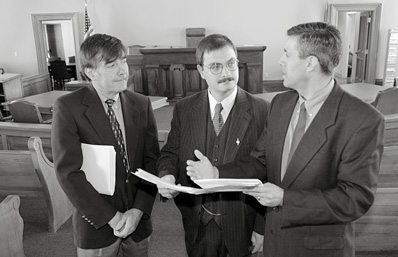 Gardner
entered law school because she dreamed of practicing environmental law.
Although her experiences in the program have her considering career possibilities
in criminal law, she has applied for a grant to work in Augusta, Ga., on
local water-quality issues.
Gardner
entered law school because she dreamed of practicing environmental law.
Although her experiences in the program have her considering career possibilities
in criminal law, she has applied for a grant to work in Augusta, Ga., on
local water-quality issues."Prospective employers recognize the value of the practical training both programs offer," Cornacchione says. "Normally when they interview students in law school, they're interviewing people who haven't experienced anything. Moot court doesn't really count," he says. "But when the interviewers hear about this program, they sit up and get interested. They really love it that I've had courtroom experience, even just a little, because that's real experience that most graduates don't have."
Both programs have several goals, says National Center for Justice and the Rule of the Law Director Thomas K. Clancy. "While educating students is certainly foremost, each program is developing model educational approaches that can be emulated by other law schools. In addition, both seek to improve the administration of justice. The prosecutorial component is devising ways to help smaller prosecutor offices operate more efficiently, and the criminal appeals program will be expanding to provide continuing legal education opportunities in appellate advocacy."
Mitchell Diggs is a communications specialist in UM Media and Public Relations.